
 Connect With Our Team
Benefits of Toe Exercises for Foot Strength and Balance
Toe exercises may seem small, but they can play an important role in how your feet function every day. Your toes help with balance, push-off, stability, walking, standing, and adjusting to different surfaces. When the muscles in the toes and feet become weak, stiff, or underused, the rest of the foot may have to work harder.
For many patients, foot pain is not caused by one single issue. It may involve weakness, tightness, poor shoe support, altered walking patterns, previous injury, arthritis, tendon strain, or pressure on certain areas of the foot. Toe exercises are not a cure for every condition, but they may be one helpful part of improving strength, mobility, and overall foot support.
At Neighborhood Foot and Ankle in Dallas, Texas, Dr. Jonathan Pajouh and Dr. Veena Devaraju help patients understand what may be contributing to foot pain, weakness, stiffness, or instability. For patients in Dallas and nearby Richardson, a podiatry evaluation can help determine whether toe exercises, footwear changes, orthotics, stretching, or additional treatment may be appropriate.
Why Do Toe Exercises Matter?
Your toes do more than help you fit into shoes. They help stabilize the foot with every step. When you walk, your toes assist with balance, grip, and forward movement. They also help support the arches and absorb pressure as weight shifts through the foot.
When toe strength decreases, some patients may notice changes in balance, walking comfort, or foot fatigue. Weakness in the smaller muscles of the foot may also contribute to overloading other structures, including the plantar fascia, tendons, joints, and ball of the foot.
Toe exercises may help by encouraging the foot muscles to work more actively. This can be especially useful for people who spend long hours in supportive shoes, stand on hard surfaces, have stiffness in the toes, or are recovering from certain foot and ankle concerns.
Dr. Jonathan Pajouh often explains: “Toe strength is easy to overlook until walking starts to feel different. Small movements can make a real difference when they help the foot feel steadier, stronger, and better supported.”
Strength, Balance, and Mobility
Toe exercises may support several important areas of foot health. The goal is not to force movement or push through pain. Instead, the focus is controlled, gentle activation of the muscles that help support the foot.
Potential benefits may include:
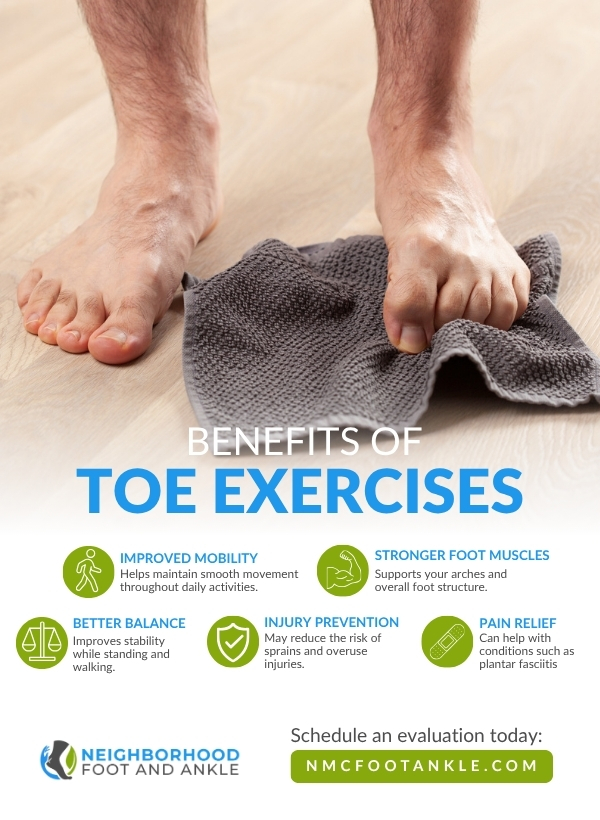
Stronger foot muscles: Toe curls, toe spreads, and towel-grip exercises can help activate the smaller muscles that support the arches and overall foot structure.
Better balance: Stronger toes may help improve stability during standing, walking, turning, and stepping on uneven ground.
Improved mobility: Gentle toe movement may help reduce stiffness and support smoother motion during daily activities.
Toe exercises can be especially helpful when they are paired with other foot health habits. Supportive shoes or inserts, gradual activity changes, calf stretching, proper recovery after activity, and early attention to pain may all play a role in keeping the feet moving well.
When Can Toe Exercises Help?
Toe exercises may be recommended for several common foot concerns, depending on the diagnosis and the patient’s symptoms. They may be used as part of a broader care plan for stiffness, weakness, balance concerns, mild toe mobility issues, plantar fasciitis support, or recovery after certain injuries.
For example, patients with plantar fasciitis may benefit from strengthening and stretching routines that address the foot, toes, calf, and arch. Patients with toe stiffness may use gentle mobility work to help maintain range of motion. Patients who feel unstable while walking may need strengthening, balance training, footwear guidance, or evaluation for underlying nerve, tendon, or joint problems.
Toe exercises may be helpful for:
- Foot fatigue after standing or walking
- Toe stiffness or reduced flexibility
- Balance or stability concerns
- Arch support and intrinsic foot strengthening
- Recovery support after certain foot or ankle injuries
However, not every foot problem should be treated with exercises alone. Pain, swelling, numbness, tingling, wounds, severe stiffness, sudden weakness, or difficulty bearing weight should be evaluated. Exercises that are helpful for one condition may aggravate another if the cause of pain is not properly identified.
Toe Exercises Should Be Done Safely
Simple exercises can still cause irritation if they are done too aggressively. Patients should avoid forcing the toes into painful positions, overdoing repetitions, or continuing an exercise that causes sharp pain.
A few common examples include toe spreads, towel scrunches, marble pickups, big-toe lifts, and gentle toe curls. These movements may help activate muscles that are often underused during normal daily walking. For many people, consistency matters more than intensity.
It is also important to consider the full picture. If foot weakness is related to nerve changes, diabetes, arthritis, tendon dysfunction, bunions, hammertoes, or an old injury, a podiatrist may recommend a more specific plan. This may include imaging, custom orthotics, padding, shoe changes, stretching, bracing, therapy, or other treatment options.
Small Movements Can Support Better Foot Function
Toe exercises are simple, but they can be a useful reminder that foot health depends on strength, movement, support, and early care. Stronger toes may help with balance, mobility, arch support, and walking comfort, especially when combined with proper shoes and a treatment plan that matches the cause of symptoms.
If you are dealing with foot pain, weakness, stiffness, balance problems, or changes in the way you walk, it may be time to schedule an evaluation. Neighborhood Foot and Ankle in Dallas, Texas, provides foot and ankle care for patients in Dallas and surrounding DFW communities.
Book Your Appointment
Published by Neighborhood Foot and Ankle | Dr. Pajouh and Dr. Devaraju | Serving Dallas and surrounding DFW | 972-726-6464.
Educational purposes only. Not medical advice.