
 Connect With Our Team
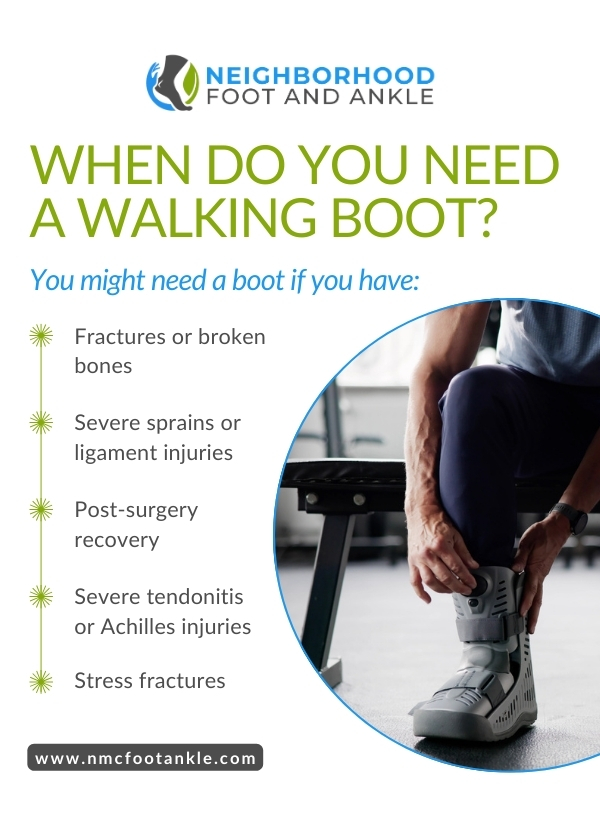
Foot and ankle injuries can interrupt daily life quickly. Whether caused by a sudden misstep, a sports injury, or repetitive stress, proper stabilization plays a key role in safe healing. A walking boot is often prescribed to protect injured structures while allowing limited, controlled movement.
At NMC Foot & Ankle in Dallas, Dr. Pajouh, DPM and Dr. Devaraju, DPM evaluate patients with a wide range of conditions that may require temporary immobilization. A walking boot is not reserved only for severe injuries. It is a medical device designed to reduce strain, maintain alignment, and support recovery.
What Does a Walking Boot Actually Do?
A walking boot, sometimes referred to as a controlled ankle motion boot, limits movement in the foot and ankle while redistributing weight away from the injured area. Unlike a traditional cast, it provides structured support with adjustable straps and cushioning, allowing for protection without completely restricting daily function. This controlled stabilization helps prevent further damage, reduces inflammation, and creates an environment where bones, ligaments, and tendons can heal in proper alignment.
By limiting excessive motion such as twisting, flexing, or side-to-side shifting, the boot reduces mechanical stress on injured tissues. It also helps decrease pain by offloading pressure from sensitive areas during standing and walking.
A boot may help:
- Stabilize fractures or broken bones
- Protect ligaments after a severe sprain
- Reduce stress on inflamed tendons
- Support healing after foot or ankle surgery
- Prevent worsening of stress fractures
By minimizing unnecessary motion, the boot allows tissues to recover without repeated irritation from everyday walking.
Dr. Devaraju explains, “Immobilization is sometimes the most important first step in healing. A walking boot protects the injured area while still allowing patients to move safely during recovery.”
Common Conditions That May Require a Boot
Many patients are surprised to learn that walking boots are used for more than obvious fractures. In an active community like Dallas, both sudden injuries and overuse conditions are common due to sports, fitness routines, long work hours on your feet, and everyday activity. Immobilization is often recommended not just for dramatic injuries, but also for conditions that need structured support to prevent worsening.
Conditions that may require a walking boot include:
- Foot or ankle fractures
- Severe ankle sprains involving ligament damage
- Achilles tendon injuries
- Severe tendonitis that has not improved with rest
- Stress fractures caused by repetitive impact
- Post-surgical recovery
Stress fractures often begin as mild discomfort and gradually worsen over time. Because the pain may seem manageable at first, many people continue their normal routines. Without protection, the small crack in the bone can enlarge, leading to a longer recovery. A walking boot reduces repetitive pressure and allows the bone adequate time to repair.
Severe sprains may also benefit from immobilization. When ligaments are overstretched or partially torn, the ankle can become unstable. Stabilization with a boot limits side-to-side movement, reduces strain, and protects the joint while the damaged tissues heal properly.
How Long Do You Need to Wear a Walking Boot?
The timeline varies depending on the severity and type of injury. Some patients require only a few weeks of protection, while others need longer immobilization based on imaging results, the specific structure involved, and how the body is responding to treatment. Healing is not one-size-fits-all, which is why individualized care is essential.
Factors that influence duration include:
- Extent of bone or ligament damage
- Whether surgery was performed
- Overall health and circulation
- Activity level and weight-bearing demands
It is important not to stop wearing the boot too early. Premature return to full activity can delay healing or lead to reinjury.
At NMC Foot & Ankle our licensed podiatrists carefully monitor your progress with follow-up evaluations and imaging when needed. As healing improves, they guide you through a gradual transition out of the boot and into supportive footwear or rehabilitation. Our goal is not only to help you heal, but to ensure you return to activity safely and confidently without long-term instability or recurring pain.
Is a Walking Boot the Only Treatment You Need?
A walking boot is often one phase of a larger treatment plan. Once the injured area has stabilized, additional care may be necessary to restore strength and flexibility.
After immobilization, patients may benefit from:
- Gradual return-to-activity guidance
- Stretching and strengthening exercises
- Custom orthotics if biomechanical issues are present
- Ongoing evaluation to prevent chronic instability
Without proper follow-up care, stiffness and weakness may persist even after the initial injury has healed.
If you are experiencing persistent foot or ankle pain, swelling, bruising, difficulty bearing weight, or instability, a professional evaluation is recommended. What feels minor could involve deeper structural damage.
At NMC Foot & Ankle in Dallas, Dr. Pajouh, DPM and Dr. Devaraju, DPM provide comprehensive evaluations and personalized treatment plans. If you are unsure whether a walking boot is right for your injury, schedule an appointment to protect your recovery and prevent long-term complications.
*For educational purposes only. Not medical advice