
 Connect With Our Team
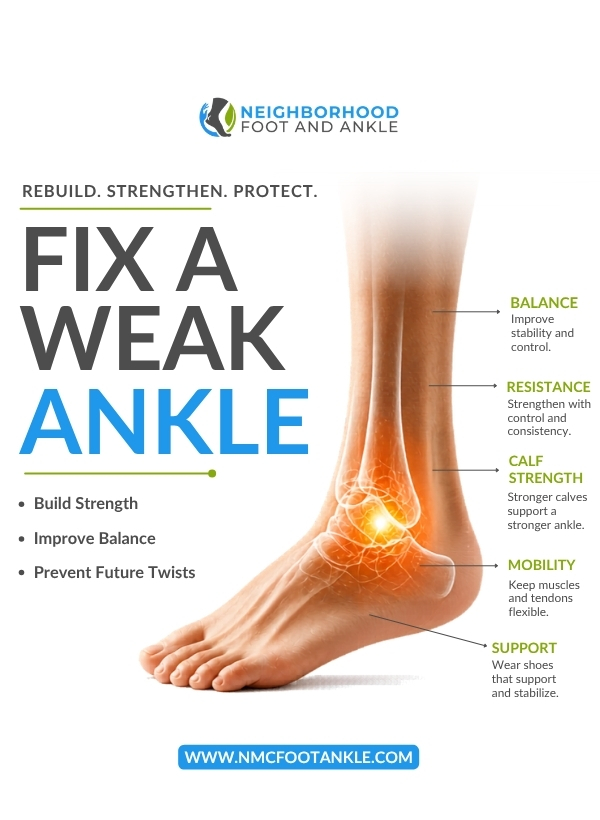 How to Fix a Weak Ankle
A weak ankle can make everyday movement feel uncertain. You may notice your ankle rolling easily, feeling unsteady on uneven ground, or becoming sore after walking, exercising, or standing for long periods. For some people, ankle weakness starts after a sprain that never fully healed. For others, it may develop slowly because of poor support, muscle imbalance, tendon strain, flat feet, high arches, or repeated minor injuries.
The ankle depends on muscles, tendons, ligaments, joints, and nerves working together. When one part of that system is not supporting movement well, the ankle may feel unstable. This can lead to frequent twists, balance problems, swelling, pain, or hesitation during activity.
At Neighborhood Foot and Ankle in Dallas, Texas, our licensed podiatrists Dr. Pajouh and Dr. Devaraju help patients understand why their ankle feels weak and what can be done to improve stability safely.
Why Does an Ankle Become Weak?
An ankle can become weak for several reasons, and the cause matters. Treating ankle weakness without understanding the source can lead to repeat injuries or ongoing instability.
Common causes of ankle weakness include:
- Previous ankle injuries
- Stretched or injured ligaments
- Tendon weakness or inflammation
- Flat feet, high arches, or poor support
- Unsupportive shoes or returning to activity too soon
A past ankle sprain is one of the most common reasons for weakness. When the ligaments are stretched or torn, the ankle may not regain full strength and control without proper rehab. Even when pain improves, the joint may still be unstable underneath. That is why some people feel like they “always roll the same ankle.”
Weak ankles can also develop when the muscles around the foot, calf, and lower leg are not strong enough to support movement. These muscles help control how the ankle lands, turns, pushes off, and absorbs impact. If they are weak or tight, the ankle may have to work harder than it should.
Can Exercise Help a Weak Ankle?
Yes, exercise can help a weak ankle when it is done safely and consistently. The goal is not just to build strength. It is also to improve balance, flexibility, coordination, and control.
Balance training is often a helpful starting point. Standing on one foot helps retrain the small stabilizing muscles around the ankle. Over time, this can be progressed by standing on a cushion, using a wobble board, or adding controlled movement.
Helpful ankle-strengthening exercises may include:
- Balance training to improve stability
- Resistance band exercises for ankle control
- Calf raises to strengthen lower leg support
- Gentle stretching for the calves and Achilles tendon
- Mobility work to improve safe range of motion
Resistance exercises strengthen the muscles that support the ankle in multiple directions. This matters because many ankle injuries happen when the foot twists or rolls unexpectedly. Calf raises are also useful because the calf muscles support walking strength, push-off power, and ankle control.
Dr. Devaraju explains it simply: “A weak ankle often needs more than rest. Once we know what is causing the instability, we can guide patients toward the right strengthening, support, and treatment plan so they can move with more confidence.”
Supportive Shoes and Daily Ankle Stability
Footwear can make a major difference for weak ankles. Shoes that are worn out, too flexible, or poorly supportive may increase the risk of rolling the ankle again. A good shoe should support the arch, secure the heel, and provide enough structure for daily movement or exercise.
Support needs can vary depending on foot shape and activity level. Flat feet may need more arch support, while high arches may need added cushioning and stability. Athletes may also need sport-specific support because quick turns, jumping, and running place more stress on the ankle.
For some patients, supportive shoes may be enough. Others may benefit from custom orthotics, ankle bracing, or rehabilitation to improve strength and control.
When Should You See a Podiatrist for Ankle Weakness?
You should see a podiatrist if your ankle keeps rolling, feels unstable, swells often, causes pain, or does not improve with basic strengthening and support. Ongoing ankle weakness should not be ignored, especially if it affects walking, work, exercise, or balance.
A podiatrist can evaluate ligament stability, tendon strength, foot alignment, and joint motion. Imaging such as X-rays, ultrasound, or MRI may be recommended when needed to check for a soft tissue injury, joint problem, tendon issue, arthritis, or another cause.
Treatment may include strengthening exercises, stretching, supportive shoes, custom orthotics, ankle bracing, rehabilitation, anti-inflammatory care, or regenerative medicine when appropriate. Surgery is typically only considered when conservative care is not enough.
Building Stronger Ankles for Better Movement
A weak ankle can affect more than the ankle itself. It can change how you walk, limit exercise, increase fall risk, and place extra stress on the foot, knee, hip, or back. Strengthening the ankle can help improve stability, but it should be done with the right support and guidance.
At Neighborhood Foot and Ankle in Dallas, Dr. Pajouh and Dr. Devaraju help patients improve function, reduce repeat injuries, and feel more secure with movement. If your ankle feels unstable, rolls easily, or keeps bothering you after activity, scheduling an evaluation can help you understand what is really going on and choose the right next step.
Book Your Ankle Exam Now
Published by Neighborhood Foot and Ankle | Dr. Pajouh and Dr. Devaraju | Serving Dallas and surrounding DFW | 972-726-6464
Educational purposes only. Not medical advice.