
 Connect With Our Team
Tarsal Coalition: Foot Pain and Stiffness
Tarsal coalition is one of those foot conditions many people have never heard of until there's pain, stiffness, or trouble keeping up. It happens when two or more bones in the back of the foot are connected in a way they should not be. That connection may be made of bone, cartilage, or fibrous tissue.
Because the back of the foot helps with side-to-side motion, a tarsal coalition can make the foot feel stiff or less flexible. Some people may also develop a rigid flatfoot, meaning the arch stays flat and does not move normally when standing, walking, or rising onto the toes.
At Neighborhood Foot and Ankle in Dallas, Texas, Dr. Jonathan Pajouh and Dr. Veena Devaraju evaluate children, teens, and adults with foot pain, stiffness, flatfoot concerns, and activity-related symptoms. For families in Dallas and nearby Garland, an exam can help identify whether symptoms are related to tarsal coalition or another foot and ankle condition.
What Is a Tarsal Coalition?
A tarsal coalition is an abnormal connection between bones in the rearfoot or midfoot. The tarsal bones help form the back and middle part of the foot, and they are important for movement, stability, and adapting to uneven ground.
When two bones are connected, motion can become limited. This may place extra stress on surrounding joints, tendons, and ligaments. Some patients have a coalition and never notice symptoms. Others develop pain as the bones mature and the connection becomes more rigid.
Symptoms often become more noticeable during childhood or adolescence because the foot is still developing. Sports, running, jumping, and long periods of walking may bring the issue to the surface.
“Tarsal coalition can be frustrating because the foot may feel stiff, sore, or limited without an obvious injury. When those symptoms keep coming back, we need to finding out whether the bones and joints are moving the way they should.” - Dr. Veena Devaraju, board certified Podiatrists.
Common Signs
Tarsal coalition can look different from person to person. Some people notice pain after activity, while others feel stiffness, instability, or difficulty moving the foot normally. Symptoms may be more noticeable with sports, long walks, standing for extended periods, or walking on uneven surfaces.
Possible signs include:
Recurring foot or ankle pain: discomfort may increase with activity, walking, or standing for long periods.
Rigid flatfoot: the foot may look flat and may not regain an arch when standing on tiptoe.
Stiffness or reduced motion: the foot may have limited side-to-side movement.
Some people may also experience muscle spasms, limping, frequent ankle sprains, or pain along the outside of the foot or ankle. Because these symptoms can overlap with other foot and ankle conditions, a podiatry exam is important.
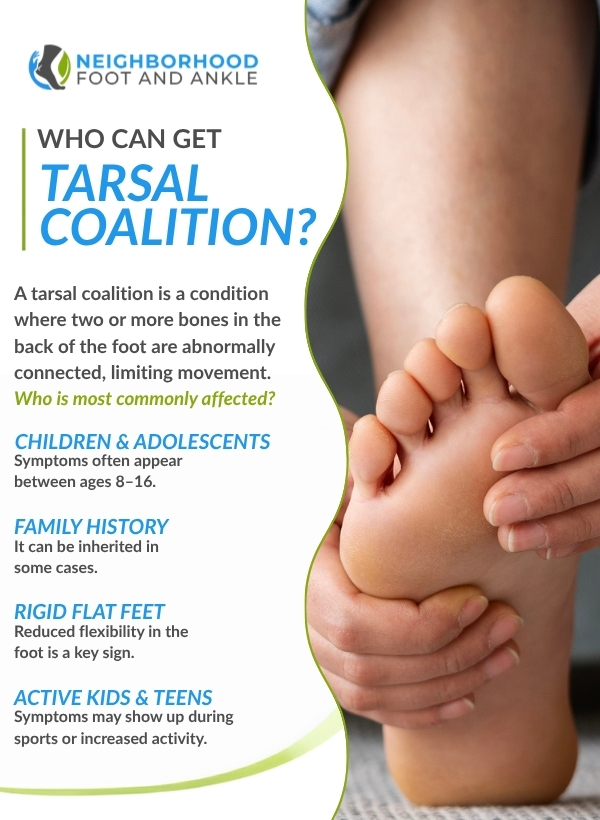
Who Can Get Tarsal Coalition?
Tarsal coalition is often present from birth, even if symptoms do not appear right away. It may become noticeable as children grow and the connection between bones becomes firmer.
Children and adolescents are most commonly affected, with symptoms often appearing between ages 8 and 16. This is a common age range because the foot is changing, activity levels are often high, and the coalition may begin limiting motion more clearly.
A family history can also play a role. In some cases, tarsal coalition may be inherited. If a parent or sibling had a similar foot problem, rigid flatfeet, or unexplained foot stiffness, it may be worth mentioning during the visit.
Active kids and teens may notice symptoms sooner because running, cutting, jumping, and sports place more demand on the feet. A child who plays soccer, basketball, football, dance, gymnastics, or track may begin feeling pain when the foot cannot move normally under stress.
How Diagnosis and Treatment May Help
A diagnosis usually begins with a physical exam. The podiatrist may evaluate foot shape, arch flexibility, walking pattern, range of motion, painful areas, and ankle stability. Imaging may also be recommended. X-rays can sometimes show the coalition, while advanced imaging may be needed when the connection is not clearly visible.
Treatment depends on symptoms, age, activity level, foot structure, and how much motion is limited. Not every case requires surgery. Many patients begin with conservative care focused on reducing pain and improving support.
Treatment may include:
Activity modification: reducing painful activity for a period of time may help calm irritation.
Supportive devices: custom orthotics, bracing, or shoe changes may help improve stability and reduce stress.
Immobilization or therapy: in some cases, a walking boot, stretching, strengthening, or guided rehab may be recommended.
When symptoms are severe, persistent, or not improving with conservative care, more advanced treatment options may be discussed. The goal is to help the patient move with less pain and avoid ongoing irritation that can affect daily activity or sports participation.
Foot Pain and Stiffness Should Not Be Ignored
Occasional soreness can happen, especially after activity or long periods on your feet. But recurring foot pain, stiffness, limping, rigid flatfeet, or repeated ankle problems should not be brushed off.
Tarsal coalition is one possible cause of ongoing foot and ankle discomfort, but it is not the only one. An accurate diagnosis can help identify what is limiting movement and what treatment options may help.
If you are dealing with foot pain, stiffness, flatfoot concerns, or trouble staying active, schedule an evaluation with Neighborhood Foot and Ankle in Dallas, Texas. Dr. Jonathan Pajouh and Dr. Veena Devaraju provide foot and ankle care for patients in Dallas and surrounding DFW communities.
Schedule Your Evaluation Online
Published by Neighborhood Foot and Ankle | Dr. Pajouh and Dr. Devaraju | Serving Dallas and surrounding DFW | 972-726-6464.
Educational purposes only. Not medical advice.