
 Connect With Our Team
Lesser Toe Surgery for Hammer Toes and Toe Deformities
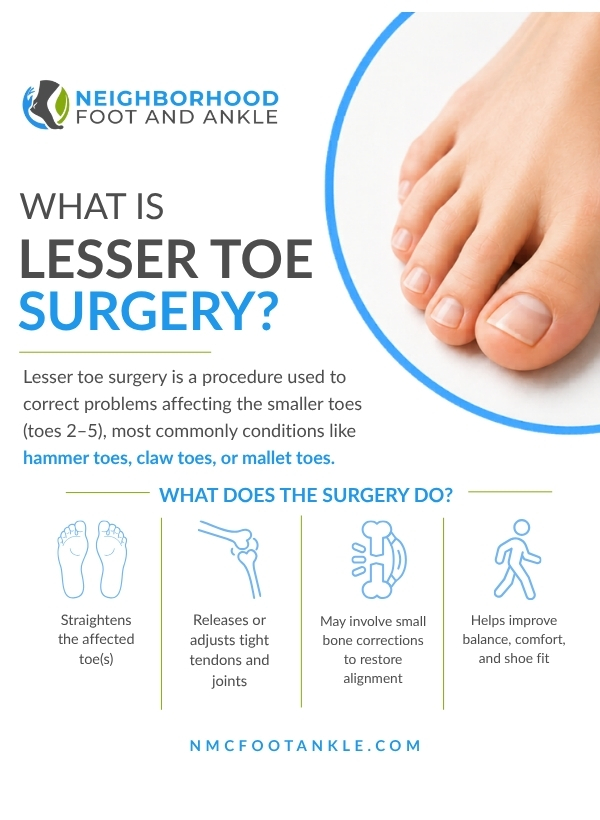
Toe pain may seem minor until it changes how you walk, limits shoe choices, or causes daily discomfort. Lesser toe surgery corrects problems affecting toes two through five, most commonly hammer toes, claw toes, and mallet toes.
These deformities can happen when the joints, tendons, and soft tissues around the toe become imbalanced. Over time, the toe may bend, curl, stiffen, or stay in an abnormal position. Patients may notice rubbing in shoes, corns, calluses, swelling, toe pain, or pressure under the ball of the foot.
At Neighborhood Foot and Ankle in Dallas, Texas, Dr. Pajouh and Dr. Devaraju evaluate lesser toe deformities to determine whether conservative care or surgery may be the right next step. For patients traveling from Addison, proper evaluation can help identify how flexible or rigid the toe has become.
What Problems Can Lesser Toe Surgery Help Correct?
Lesser toe surgery can help correct painful deformities when toe position interferes with comfort, mobility, or shoe fit. These procedures are usually considered when symptoms affect daily activity, not just appearance.
A hammer toe usually bends at the middle joint. A mallet toe affects the joint near the tip of the toe. A claw toe may bend at multiple joints, causing the toe to curl downward.
Symptoms may include:
- Pain or pressure in shoes
- Corns, calluses, or redness
- Toe stiffness or limited movement
- Rubbing on the top or tip of the toe
- Pain under the ball of the foot
- Trouble walking comfortably
In flexible cases, padding, shoe changes, splinting, orthotics, or activity adjustments may help reduce irritation. When the toe becomes rigid, painful, or continues to worsen, surgery may be discussed. The goal is to improve alignment, reduce pressure, and support better foot function.
When Is Surgery Considered for Smaller Toe Deformities?
Surgery is usually considered when a lesser toe deformity becomes painful, stiff, or difficult to manage with conservative care. A flexible toe may still straighten with gentle movement. A rigid toe may stay bent even when pressure is removed.
Rigid deformities can create ongoing shoe irritation, skin buildup, swelling, and changes in walking mechanics. Pressure from the toe position may also increase the risk of sores or skin breakdown, especially for patients with diabetes, circulation problems, or nerve concerns.
Dr. Devaraju explains it simply: “When a smaller toe becomes painful, stiff, or starts changing the way someone walks, we want to understand why. Surgery is not always the first step, but it may be helpful when the toe no longer responds to conservative care.”
An evaluation by one of our licensed podiatrists in Dallas, may include a physical exam, symptom review, footwear discussion, and imaging when needed. Dr. Pajouh and Dr. Devaraju look at toe flexibility, joint position, tendon tightness, pressure points, and related foot concerns.
How Lesser Toe Surgery Works
Lesser toe surgery is personalized based on the deformity, stiffness, and structures causing the toe to bend. The procedure may involve soft tissue work, joint correction, small bone adjustments, or a combination of approaches.
Depending on the case, surgery may help:
- Straighten the affected toe or toes
- Release tight tendons or soft tissue
- Adjust joints fixed in a bent position
- Correct small bone alignment issues
- Improve balance, comfort, and shoe fit
Some procedures use temporary pins, implants, or other fixation methods while the toe heals. It is also important to evaluate the whole foot, not just the painful toe, because lesser toe deformities can sometimes be connected to bunions, arthritis, flat feet, high arches, or gait changes.
Recovery After Lesser Toe Surgery
Recovery depends on the correction performed and how many toes are involved. Some patients may walk in a surgical shoe soon after the procedure, while others may need more protection during early healing.
Swelling is common and can take time to improve. Patients are usually given instructions for dressing care, elevation, activity limits, footwear, and follow-up visits. Following the recovery plan closely helps support proper healing.
Choosing the Right Treatment Plan
Lesser toe surgery is typically considered when hammer toes, claw toes, mallet toes, or other smaller toe deformities affect daily comfort and mobility. It may help restore better alignment when conservative care is no longer enough.
At Neighborhood Foot and Ankle in Dallas, Texas, Dr. Pajouh and Dr. Devaraju provide evaluation and treatment for painful lesser toe deformities. If toe pain is making it harder to walk, exercise, or wear shoes comfortably, scheduling an evaluation can help you understand your options.
Contact Us Now To Schedule Your Exam
Published by Neighborhood Foot and Ankle | Dr. Pajouh and Dr. Devaraju | Serving Dallas and surrounding DFW | 972-726-6464.
Educational purposes only. Not medical advice.