
 Connect With Our Team
Cheilectomy Surgery for Big Toe Arthritis and Hallux Rigidus
Big toe pain can make walking, exercising, climbing stairs, or even wearing certain shoes more difficult. When arthritis affects the big toe joint, the condition is often called hallux rigidus. This means the joint has become stiff, painful, and harder to bend during normal movement.
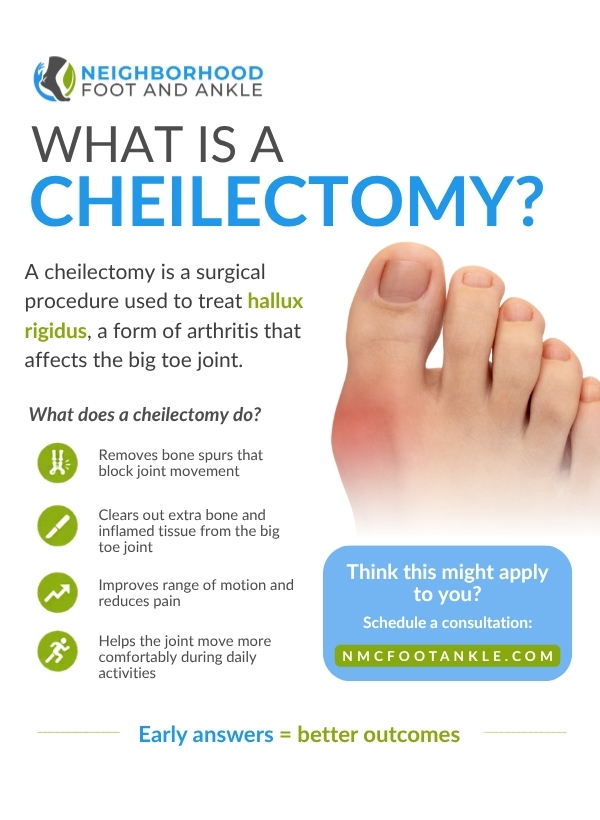
A cheilectomy is a surgical procedure used to treat hallux rigidus by removing bone spurs and extra bone that block joint motion. These bone spurs can form over time as arthritis develops in the big toe joint. As the joint becomes more crowded and irritated, bending the toe may become painful, especially when pushing off the foot while walking or running.
At Neighborhood Foot and Ankle in Dallas, Texas, Dr. Pajouh and Dr. Devaraju evaluate big toe joint pain to determine whether conservative care or surgery may be the right next step. For patients traveling from Farmers Branch, a proper diagnosis can help identify whether stiffness is coming from arthritis, bone spurs, joint damage, or another foot concern.
What Is a Cheilectomy Used to Treat?
A cheilectomy is most commonly used to treat hallux rigidus, which is arthritis of the big toe joint. This joint plays an important role in walking because it needs to bend each time the foot pushes off the ground. When motion becomes limited, the body may start adjusting the way it moves to avoid pain.
Hallux rigidus can cause symptoms such as:
- Pain in the big toe joint
- Stiffness or limited motion
- Swelling around the joint
- Bone spurs or a bump on top of the joint
- Pain when walking, running, or pushing off
- Trouble wearing shoes comfortably
In earlier stages, hallux rigidus may cause mild aching or stiffness. Over time, symptoms can become more noticeable. Some patients feel pain mostly during activity, while others may have discomfort even with normal daily walking.
A cheilectomy may be considered when bone spurs are blocking motion but the joint still has enough healthy cartilage to benefit from improved movement. The goal is to reduce painful catching, rubbing, and stiffness so the big toe joint can move more comfortably.
When Is Cheilectomy Surgery Recommended?
Cheilectomy surgery may be recommended when big toe arthritis causes pain, stiffness, and limited motion that no longer improves enough with conservative care. Before discussing surgery, a podiatrist may recommend shoe changes, orthotics, anti-inflammatory treatments, activity adjustments, padding, injections, or other nonsurgical options.
Conservative care can be helpful, especially when symptoms are mild. However, if bone spurs continue to block motion or pain begins affecting daily life, surgery may become part of the conversation.
Dr. Pajouh explains it simply: “The big toe joint does a lot of work with every step. When arthritis and bone spurs limit motion, patients may start changing how they walk without realizing it. A cheilectomy can be helpful when the goal is to remove the blockage and help the joint move more comfortably.”
A full evaluation is important because not every patient with hallux rigidus is a candidate for cheilectomy. If arthritis is advanced and the joint is severely damaged, other procedures may be more appropriate. The right treatment depends on the stage of arthritis, joint motion, pain level, activity goals, and overall foot structure.
How a Cheilectomy Works
During a cheilectomy, the surgeon removes bone spurs and extra bone from around the big toe joint. Inflamed tissue may also be cleared from the joint area when needed. This helps create more space so the joint can move with less restriction.
The procedure may help:
- Remove bone spurs that block motion
- Reduce painful pressure around the joint
- Improve range of motion
- Help the toe bend more comfortably
- Support better walking mechanics
- Make shoe wear easier for some patients
A cheilectomy does not replace the joint or remove arthritis completely. Instead, it addresses the bony blockage and irritation that can make the joint stiff and painful. That is why proper patient selection matters. The procedure is often most helpful when arthritis is present but the joint still has enough function to preserve motion.
Recovery After Cheilectomy Surgery
Recovery after cheilectomy surgery depends on the severity of the condition, the amount of correction performed, and the patient’s overall health. Some patients may be able to walk in a surgical shoe soon after the procedure, while others may need more protection during early healing.
Swelling, soreness, and stiffness are common during recovery. Patients are usually given instructions for dressing care, elevation, activity limits, footwear, and follow-up visits. As healing progresses, gradual movement may be recommended to help restore motion and reduce stiffness.
The goal of recovery is to help the joint heal while slowly returning to more comfortable walking. Following the post-operative plan closely can make a meaningful difference in comfort, motion, and long-term results.
Choosing the Right Care for Big Toe Joint Pain
Big toe arthritis can affect more than the toe itself. When the joint does not move well, the foot may compensate, which can lead to discomfort in other areas of the foot, ankle, knee, or hip. Getting evaluated early can help patients understand what is causing the pain and which treatment options make sense.
At Neighborhood Foot and Ankle in Dallas, Texas, Dr. Pajouh and Dr. Devaraju provide evaluation and treatment for hallux rigidus, bone spurs, and big toe joint pain. If stiffness or pain in the big toe is making it harder to walk, exercise, or wear shoes comfortably, scheduling an evaluation can help you take the next step toward relief.
Book Your Big Toe Consult Here
Published by Neighborhood Foot and Ankle | Dr. Pajouh and Dr. Devaraju | Serving Dallas and surrounding DFW | 972-726-6464.
Educational purposes only. Not medical advice.