
 Connect With Our Team
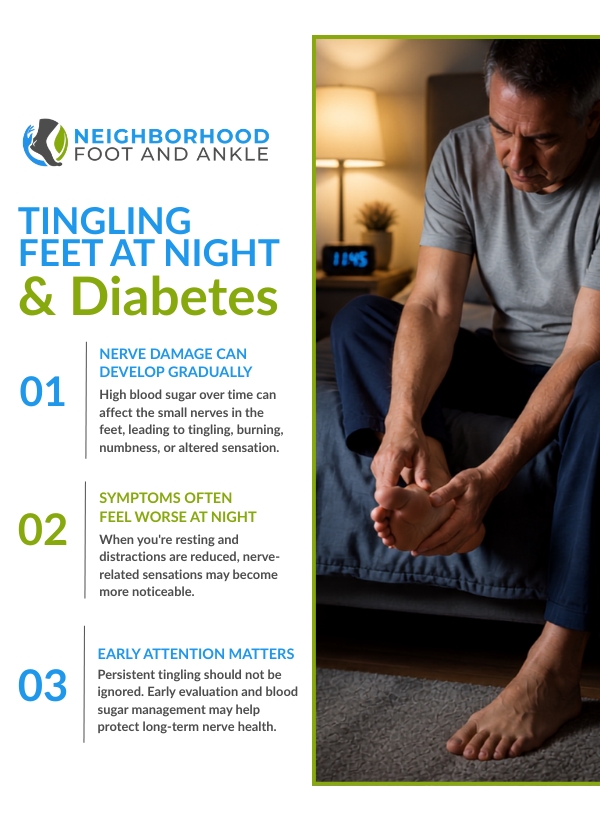
Tingling Feet at Night: Why Diabetes Should Not Be Overlooked
Tingling feet at night can feel strange, uncomfortable, and sometimes unsettling. Some people describe it as pins and needles. Others notice burning, buzzing, stinging, numbness, or the feeling that their feet are “asleep” even when they have not been sitting in an unusual position.
For many patients, these symptoms are more noticeable at night because the day is finally quiet. There are fewer distractions, the feet are at rest, and small nerve changes may become harder to ignore.
Occasional tingling can happen for different reasons, but recurring nighttime tingling should not be brushed off. At Neighborhood Foot and Ankle in Dallas, Texas, licensed podiatrists Dr. Jonathan Pajouh and Dr. Veena Devaraju evaluate foot numbness, burning, tingling, nerve pain, and diabetic foot concerns for patients in Dallas and nearby Richardson.
What Can Cause Tingling Feet at Night?
Tingling feet can come from several different sources. Sometimes it is related to pressure on a nerve, circulation changes, vitamin deficiencies, back problems, shoe pressure, or inflammation around the foot and ankle.
One cause that should not be overlooked is diabetic peripheral neuropathy. Over time, elevated blood sugar can damage the small nerves in the feet. When those nerves are affected, normal sensation may change. Some patients feel pain, burning, tingling, or buzzing. Others begin to lose feeling in parts of the foot.
Common sensations may include:
• Pins and needles
• Burning or stinging
• Buzzing or crawling feelings
• Numbness or reduced feeling
• Sharp or shooting nerve pain
The symptoms may be mild at first, but nerve changes can progress. That is why early evaluation matters, especially for patients with diabetes, prediabetes, or a history of blood sugar concerns.
Why Can Symptoms Feel Worse at Night?
Nighttime symptoms do not always mean the condition is suddenly worse. Often, the sensations are simply easier to notice when the body is still.
During the day, walking, working, errands, conversations, and activity can distract from subtle symptoms. At night, when you are lying down and trying to rest, tingling or burning may feel much more obvious.
For some patients, nighttime tingling may be one of the first signs that nerve health needs attention. It may also be a sign that blood sugar management, circulation, shoe fit, or pressure points should be reviewed.
Dr. Veena Devaraju explains, “When patients tell us their feet tingle or burn at night, we don't want them to assume it's just part of getting older. Those symptoms can give us important clues about nerve health, circulation, and diabetic foot risk.”
Diabetes and Nerve Health in the Feet
Diabetic peripheral neuropathy often starts in the feet because the nerves there are long and can be affected early. Symptoms may begin in the toes, balls of the feet, or soles, then gradually become more noticeable.
This matters because neuropathy can change more than comfort. If feeling is reduced, a person may not notice rubbing from a shoe, a small cut, a blister, a callus, or pressure under the foot. Without early care, minor skin problems can become more serious, especially when circulation or healing is also affected.
A diabetic foot exam can help evaluate:
• Sensation and nerve response
• Skin and nail health
• Circulation in the feet
• Pressure points and calluses
• Wound risk and shoe fit
These visits are not only for patients who already have a wound. They are also for prevention.
Other Possible Causes of Tingling Feet
Diabetes is important to consider, but it is not the only possible cause of nighttime tingling. Circulation problems, nerve compression, vitamin deficiencies, thyroid concerns, medication side effects, lower back nerve irritation, and foot structure issues may also play a role.
That is why a podiatry evaluation focuses on the full picture. The goal is to understand where the symptoms are coming from instead of guessing or only treating the discomfort.
Your podiatrist may ask when the tingling started, whether it affects one foot or both, whether numbness is present, whether symptoms happen only at night, and whether you have diabetes or circulation concerns.
When Should You Schedule an Evaluation?
You should schedule an evaluation if tingling keeps happening, worsens, affects sleep, comes with numbness, or is paired with burning, weakness, wounds, skin changes, or balance concerns.
This is especially important if you have diabetes, prediabetes, circulation issues, kidney disease, or a history of foot wounds.
Early evaluation can help identify nerve changes, reduce foot risk, and guide next steps. Blood sugar management is also an important part of protecting long-term nerve health.
Protect Your Nerve Health and Foot Health
Tingling feet at night may seem minor at first, but recurring symptoms deserve attention. Pins and needles, burning, buzzing, numbness, or altered sensation can be signs that the nerves in the feet need to be evaluated.
If you are experiencing nighttime tingling, diabetic foot symptoms, numbness, burning pain, or concerns about neuropathy we want to hear from you.
Schedule an Evaluation with Neighborhood Foot and Ankle
Published by Neighborhood Foot and Ankle | Dr. Pajouh and Dr. Devaraju | Serving Dallas and surrounding DFW | 972-726-6464.
Educational purposes only. Not medical advice.