
 Connect With Our Team
Tibial Plafond Fracture Treatment in Dallas
A tibial plafond fracture is not a simple ankle injury. It involves the lower end of the tibia, or shinbone, where the bone forms the top part of the ankle joint. Because this area helps support body weight and allows the ankle to move, a fracture here can seriously affect walking, standing, balance, and long-term joint function.
At Neighborhood Foot and Ankle in Dallas, Texas, Dr. Jonathan Pajouh and Dr. Veena Devaraju evaluate severe ankle injuries for patients throughout Dallas and nearby Addison. Prompt evaluation matters because tibial plafond fractures can involve the joint surface, surrounding soft tissue, cartilage, and overall ankle alignment.
Understanding Tibial Plafond Fractures
The tibial plafond is the weight-bearing surface at the bottom of the tibia. When this area breaks, the injury often affects more than just the bone. The ankle joint may become unstable, swollen, painful, or difficult to move.
These fractures are often considered serious because the injury happens in a part of the ankle that must handle pressure every time you stand or walk. If the joint surface heals unevenly, it may increase the risk of stiffness, chronic pain, arthritis, or mobility problems later.
Some tibial plafond fractures are relatively contained, while others are complex and involve multiple bone fragments. The severity depends on the force of the injury, whether the bone shifted out of place, and how much damage occurred to the joint and surrounding tissues.
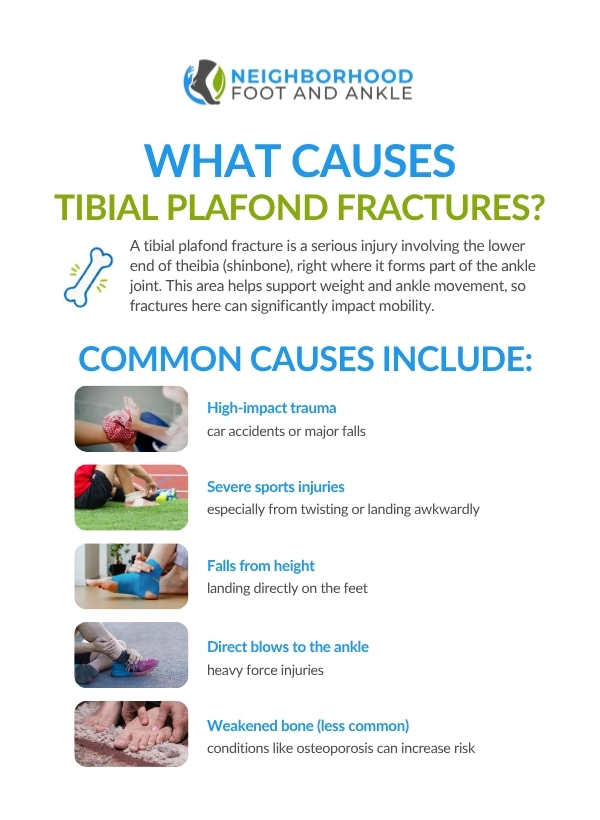
What Causes a Tibial Plafond Fracture?
Tibial plafond fractures are commonly caused by high-energy trauma. Because the ankle absorbs a major force during the injury, these fractures often happen suddenly and can be extremely painful.
Common causes include:
- Car accidents or other high-impact trauma
- Falls from a height, especially landing directly on the feet
- Severe sports injuries from twisting, collision, or awkward landings
- Direct blows to the ankle
- Work-related accidents or crush injuries
- Weakened bone from conditions such as osteoporosis, though this is less common
In many cases, the foot is forced upward into the tibia, causing the lower part of the shinbone to break near the ankle joint. This is why the injury may occur after falling from a ladder, landing hard after a jump, or being involved in a vehicle accident.
Symptoms That Should Not Be Ignored
A tibial plafond fracture usually causes significant symptoms right away. Some people may know immediately that something is seriously wrong, while others may assume it is a bad sprain at first.
Warning signs may include:
- Severe ankle pain
- Rapid swelling
- Bruising around the ankle or lower leg
- Difficulty or inability to bear weight
- Visible deformity or abnormal ankle position
- Tenderness near the lower shin or ankle joint
- Pain that worsens with movement
- Numbness, tingling, or tightness in the foot or ankle
Any severe ankle injury after a fall, accident, or direct impact should be evaluated as soon as possible. Walking on a serious fracture can worsen alignment, increase pain, and make treatment more complicated.
When Should You See a Podiatrist After a Severe Ankle Injury?
You should schedule an evaluation right away if ankle pain is severe, swelling develops quickly, or you cannot comfortably bear weight. A tibial plafond fracture is not something to “walk off.”
Dr. Pajouh explains, “When someone has severe ankle pain after a fall or accident, the priority is making sure the joint is aligned and stable so we can protect long-term function.”
An exam may include a physical evaluation, X-rays, and sometimes advanced imaging such as a CT scan. Imaging helps determine whether the fracture involves the joint surface, how many fragments are present, and whether surgery may be needed.
Early diagnosis helps guide the safest next step. It also helps reduce the risk of complications such as poor healing, ankle stiffness, chronic swelling, and post-traumatic arthritis.
Treatment Options for Tibial Plafond Fractures
Treatment depends on the severity of the fracture. Some stable fractures may be treated without surgery, especially if the bones remain properly aligned. More complex fractures often require surgical repair to restore ankle alignment and joint function.
Conservative treatment may include:
- Immobilization with a splint, cast, or fracture boot
- Strict non-weight-bearing instructions
- Crutches, walker, or knee scooter use
- Elevation and swelling control
- Follow-up imaging to monitor healing
Surgical treatment may be recommended when the bone fragments are displaced, the joint surface is disrupted, or the ankle is unstable. Surgery may involve plates, screws, or other fixation methods to help restore alignment while the bone heals.
Recovery can take time. Rehabilitation may be needed after the bone heals enough to safely begin movement and strengthening. The goal is to restore mobility, reduce stiffness, and help patients return to daily activity as safely as possible.
Why Follow-Up Care Matters
Tibial plafond fractures can affect the ankle long after the initial injury. Even with proper treatment, patients may experience stiffness, swelling, weakness, or arthritis risk because the fracture involves the joint surface.
Follow-up care allows your podiatrist to monitor healing, check alignment, adjust weight-bearing instructions, and identify any concerns early. Skipping follow-up visits can make it harder to catch delayed healing or joint problems before they become more serious.
A careful treatment plan can make a major difference in long-term comfort and mobility.
Get Severe Ankle Pain Evaluated
If you have severe ankle pain after a fall, car accident, sports injury, or direct impact, do not assume it is just a sprain. A tibial plafond fracture is a serious ankle injury that needs timely evaluation and appropriate care.
Schedule an appointment with Neighborhood Foot and Ankle in Dallas, TX. Dr. Jonathan Pajouh and Dr. Veena Devaraju provide foot and ankle care for patients in Dallas and nearby Addison, TX.
Published by Neighborhood Foot and Ankle | Dr. Pajouh and Dr. Devaraju | Serving Dallas and surrounding DFW | 972-726-6464.
Educational purposes only. Not medical advice.