
 Connect With Our Team
When Big Toe Stiffness Is More Than Just Soreness
Stiffness in the big toe is easy to brush off. Many adults assume it is part of aging, overuse, or a long day on their feet. But when that stiffness becomes persistent, painful, or starts to limit movement, it may be a sign of hallux rigidus, a form of arthritis that affects the big toe joint.
At NMC Foot & Ankle, in Dallas, Texas Dr. Jonathan Pajouh and Dr. Veena Devaraju frequently see patients who delayed care because early symptoms felt mild or inconsistent. Understanding how hallux rigidus develops and what early warning signs look like can make a meaningful difference in preserving joint function and staying active.
What Is Hallux Rigidus?
Hallux rigidus is arthritis of the joint at the base of the big toe. Over time, cartilage in the joint begins to wear down, leading to stiffness, inflammation, and pain during movement. Because the big toe plays a key role in walking, running, and balance, even small changes in joint motion can affect daily comfort.
The condition often develops gradually. In its early stages, symptoms may come and go, which is why many people overlook them. Without treatment, stiffness can worsen, movement can become more limited, and everyday activities like walking or exercising may feel increasingly uncomfortable.
Why Early Symptoms Are Often Missed
Early hallux rigidus symptoms are often overlooked because they tend to come and go. Many people feel stiffness or mild discomfort only after long walks, workouts, or standing for extended periods. Since rest usually brings relief, it is easy to assume the issue is temporary. Over time, however, the joint can continue to degenerate, and what once felt like occasional soreness may turn into persistent pain or noticeable loss of motion.
At NMC Foot & Ankle, early evaluation is focused on understanding how the big toe joint is functioning now, not just how it feels on a given day. Identifying subtle changes early allows care to center on protecting the joint and slowing progression before stiffness becomes limiting.
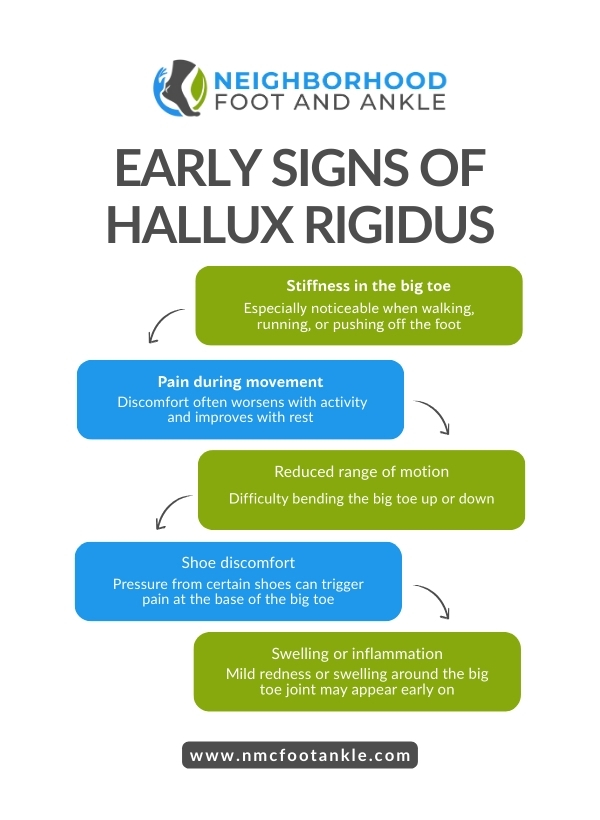
Early warning signs commonly include:
- Stiffness in the big toe, especially when pushing off while walking
- Pain during movement that improves with rest but returns with activity
- Reduced range of motion, making it harder to bend the toe up or down
- Shoe-related discomfort, particularly from styles that place pressure on the toe joint
- Mild swelling or inflammation around the base of the big toe
When these symptoms are addressed early, treatment options tend to be more flexible and less disruptive. The goal is to preserve mobility, reduce discomfort, and help patients stay active before arthritis advances.
How Is Hallux Rigidus Evaluated and Treated?
Evaluation begins with a detailed clinical exam and imaging to assess joint alignment, cartilage health, and how much motion remains in the big toe joint. Treatment is then guided by symptom severity, activity level, and how the condition is affecting daily life.
In earlier stages, care often focuses on reducing joint stress, managing inflammation, and slowing progression. At NMC Foot & Ankle, conservative treatment options may include:
- Medications, such as non-steroidal anti-inflammatory drugs to help manage pain and inflammation
- Ice therapy to reduce swelling and calm irritated joint tissues
- Shoe modifications, including stiff-soled or rocker-bottom shoes to limit painful joint motion
- Custom orthotic devices, such as footpads, braces, or splints to improve support and stability
- Injection therapy, where corticosteroids are placed directly into the MTP joint to relieve pain and inflammation
- Physical therapy, with targeted exercises to improve flexibility, range of motion, and strength
As Dr. Devaraju explains, “When patients come in early, we often have more flexibility in how we manage stiffness and protect the joint before it becomes severely limiting.”
When symptoms are more advanced or conservative options no longer provide relief, more targeted interventions may be discussed to restore comfort and preserve mobility. Because no two cases are identical, treatment planning always considers lifestyle, activity demands, and long-term goals, not just what appears on imaging.
When Big Toe Pain Should Not Be Ignored
Hallux rigidus does not improve on its own. Delaying care can allow stiffness and pain to progress, narrowing treatment options over time. Early evaluation helps preserve joint movement, reduce discomfort, and support long-term foot function so daily activities and exercise routines are less likely to be disrupted.
If big toe stiffness or pain has become familiar, a professional evaluation can provide clarity and next steps. Appointments at NMC Foot & Ankle in Dallas, Texas are available for comprehensive evaluation and personalized treatment planning to help you stay active and comfortable.